Bringing Aesthetics and Function Together in Urban Design
Perforated concrete blocks are the calmest way to hold privacy and light together in urban architecture. How Zenachi approaches that balance.
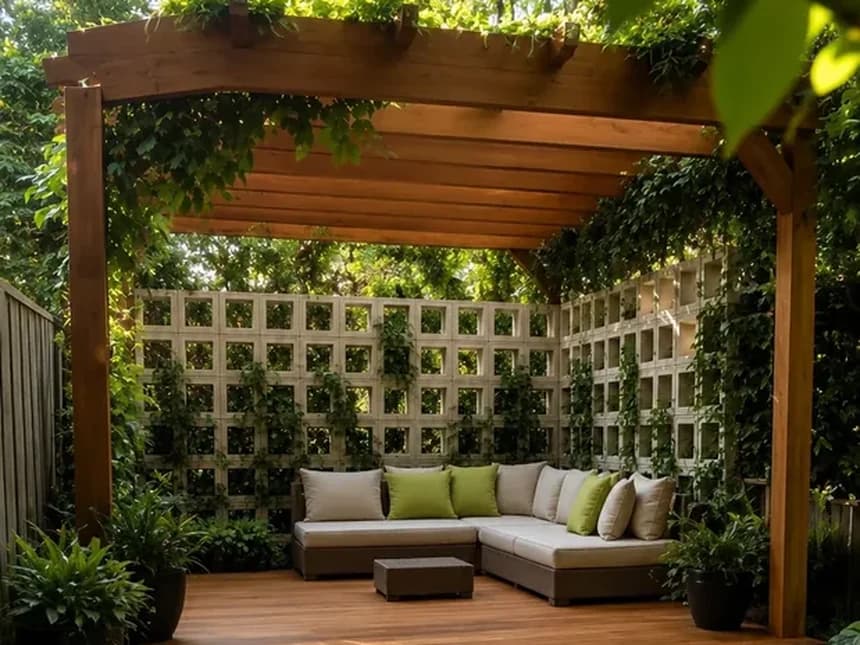
In a dense urban fabric every surface has to do two jobs at once: protect and open up, enclose and invite. Perforated concrete blocks offer a quiet, elegant answer to one of the oldest tensions in architecture, letting privacy and light coexist.
Between Visibility and Privacy
A solid wall gives security but also cuts off air, light and the view. A perforated block creates an intermediate layer between the two: from the inside the outside is glimpsed in fragments, while from the outside the eye stops at the surface without ever completing the pattern. This is exactly what architects call a soft boundary: neither fully closed nor fully open.
The Quiet Hero of Natural Ventilation
Air moving through the openings reduces the need for mechanical ventilation and provides passive cooling, especially in hot climates. At the same time the shadow patterns shift with the angle of the sun, redrawing the surface throughout the day; the morning shadow is not the same as the midday one, nor the midday the same as late afternoon. A liveliness a static wall could never provide.
The Zenachi Approach
At Zenachi every block form begins with a trace found in nature: the veining of a leaf, the ripple the wind leaves in sand, the void water carves in stone. These forms are not chosen at random: we design the amount of light they let through, the shape of the shadow and how open or closed the wall will feel, all together. The same logic works on an urban facade, along a garden boundary or as an interior partition: the material does not merely appear, it governs the space.
A good urban design decision is often hidden in the least discussed material. On your next project, consider that a wall can be more than a boundary: it can be an interface that regulates light and air.